Showing posts with label essay. Show all posts

Thursday, September 10, 2009

Elliot Magazine


Busy busy busy. It's a busy time, folks. School has started for just about everyone now. I'm on my third week, and somewhere between essays, The Picture of Dorian Gray, mes leçons françaises, and a crazy textual analysis course, I try to find times to puruse the internet for the latest and greatest music news. Granted - and if you're a regular reader on Voilà!, I'm sure you've noticed - I don't have all the time in the world. And considering I've started an art project with some international friends, and am way more addicted to Lookbook.nu than I'd normally like to admit - not even beginning to mention that I'm something of a perfectionist, and only want to deliver the best of the best musical articles to you lovely readers - sometimes I just don't have time to write the most quality article with a very high frequency every week. For that, I certainly apologize.

So there wasn't an [Ex]Band of the Week article this time around (we'll call my excuse Labour Day and the presidential speech to Congress last night). But that can only mean two awesome articles for next week! That only brings reasons to get excited to mind. But - and that perfectionist bit is showing right now - I can't just let Voilà! sit completely empty for a week. I have to do something.

Voilà! loves all things independent, from music, to cinema, to literature. We've mentioned our old friends, the Vomitorium Collective Art Concern about one year ago; the indie art magazine still feature some of the greatest contemporary artistic minds you can find on our fine planet. But all this talk of art, culture, and independence is making me tingle with excitement. Because by complete chance, I've stumbled upon something that may just be right up Voilà! readers literary alley.

Elliot Magazine is touted as being a quirky cultural collective from a duo of designers, interested in the presentation of journalistic expression. That might be one bold, longwinded, tongue twister of a claim, but you'd be hard pressed to find some sort of way to contest it! This very sleek, well designed, unique, cultural webzine literally made its inaugural launch today. Filled with 63 pages full of interviews, articles, photographer features, some music articles, Elliot Magazine is due to be an up and coming star in the online cultural scenes. And since I try to tie everything on Voilà! back to music, I'll have you know that besides a couple of neat playlists at the end of the magazine, the debut issue of Elliot Magazine features a favourite from Elliot Magazine's own home town, Toronto: a concert review of Broken Social Scene.

See how your eyes widened and ears perked up, just dying to hear a clip from "Pacific Theme?" Oh yes, reader, I knew your interests would be peaked. For our old friends at Vomitorium, editor-in-chief Brice Baum has released six wonderfully eclectic magazine issues, and is busily working on the seventh issue, due sometime in the future (hopefully soon); you can check out all the news, as well as purchase your own copy of Vomitorium from their official site. As for our new friends at Elliot Magazine, you can wander directly to the free and independent online magazine as we speak, and check out all of the lovely literature they have to offer!

Friday, May 1, 2009

All About Lily Chou-Chou


A love for music. A passion for music. An obsession for music. However you want to describe it, the truth is that there are tons of ways for people to represent how strongly they feel about the music they listen to. For some it's simple: When the album of your favourite band drops, be there to pick up the latest release. But others are more diligent, dare I say, obsessive with their music tastes. Sometimes this obsession is relished, dare I say, a compliment; it all depends on the listener.

The truth is, whether a band is the most mainstream band in the nation, or the most independent artist you can find, you'll probably also see some fans tucked in tow, some fans more infatuated than others. And in our day and age, with the viral internet world, it's incredibly easy to express your passion for almost any band on Earth.

In my experience, Japanese bands are the best at gathering a hardcore fanbase, to the point of being wildly mad for the band. While many bands can garner a huge following with graceful ease, I simply haven't ever seen anyone top what some J-rock and J-Pop bands have done. The Pillows has transcended all sorts of barriers: international boundaries, language barriers, and even genre barriers, as their music was prominently featured in the Japanese anime FLCL. Quruli has amassed a wildly extensive fanbase with their perky J-pop, while An Cafe seems to have listeners in every nook and cranny of every continent. Don't even get me started on Dir en grey, the infamous J-rock meets visual kei meets metal band that has quickly began seeping into mainstream American alt-rock. The devotion of these bands fans is incomparable.

Music and the obsession that can pervade it. The idea can almost seem ethereal at times. Neigh, at times, music can seem to have an ether flowing through it. There are a few who are graced by this mysterious ether, but they're the artists who shine forth stronger and brighter than any star in the sky. They transcend the barriers of the world with their own interpretations of the Ether, and their ability to change the world around them without batting an eyelash is what makes their Ether so strong - what makes these artists so powerfully prudent, and so unfathomable (dare I say) utopian. There is one musical artist who's Ether never needs to be judged (besides Debussy, of course). Her name is Lily Chou-Chou.

Let's talk all about Lily Chou-Chou. That's [ree-ree shu-shu] for us off the Islands of the Rising Sun. Lily Chou-Chou is in touch with the Ether. She flows with the Ether. She welcomes you to the Ether. She welcomes you with open arms. Her music is her expression of the Ether, and all us simple peasantfolk need to do is to kokyuu [breathe], and embrace the Ether with our own soul/love/ideals/passions. Lily Chou-Chou is one of the most inspirational, facinating artists to ever create music. Did I also mention she's fictional?

The movie is titled, リリイ・シュシュのすべて [All About Lily Chou-Chou], and was created and directed by Shunji Iwai. All About Lily Chou-Chou was conceived as an online novel through a Japanese BBS titled Lilyholic; some of the fictional characters from the story posted to the BBS; thus, readers of the internet novel were free to post alongside the fictional characters, integrating themselves into the novel as their own web-based characters - becoming a physical presence within the story of Lily Chou-Chou, the mysterious, reclusive, subtle, beautiful Japanese songstress her was entwined with the omnipresent, indescribable force known as the Ether.

From this online novel came All About Lily Chou-Chou, Shunji Iwai's eerie, slightly demented, yet wholly enlightening and masterfully created feature film. Telling the story of several obsessive Lily Chou-Chou, stuck in their country town surrounded by green rice fields in all directions, All About Lily Chou-Chou is truly a one of a kind film. The kids of the story are forced to grow up in reckless abandon, all the while Lily Chou-Chou is planning a huge concert at a local venue. The movie stands a triumphant masterpiece of Iwai's work as a filmmaker and writer.

All About Lily Chou-Chou is easily one of the best films of the last decade, and is definitely something you don't want to miss. How does Voilà!, a simple music blog, tie this in? Easily: All About Lily Chou-Chou offers a very honest expression of the oddity that is music in the modern age, albeit the strange story that accompanies it. It goes into everything from live shows to internet obsession (Lilyphilia, if you will); a diligently crafted story about love and loss - about growing up and learning of life's true Ether - it's true oddity and depravity - all surrounded by beautiful sounds of the fictional Lily Chou-Chou.

It's abstract, yeah, but it's a movie for true music lovers. The movie tops out over two hours, and is entirely in Japanese. It's also contains some extremely intense imagery, and is definitely not for the lighthearted. But if you're the type to stomach something intense, powerful, and magnificent all wrapped together, All About Lily Chou-Chou is right up your alley. You can find yourself a copy of All About Lily Chou-Chou on Amazon.com, at your leisure, or you can hear the wonderful sounds of Lily Chou-Chou herself (vocaled by the singer Salyu) right here, on her Myspace. Welcome to the Ether.


Friday, February 27, 2009

The Angel Riots


Ibi Dreams of Pavement (A Better Day). That's what the Broken Social Scene tells us anyway. Granted, this song is honouring indie-rock legends Pavement, but it honours another as well. Her name is Ibi Kaslik, and she's contemporary Hungarian-Canadian novelist and journalist. Besides her being generally awesome, and having a great taste in friends, she's also quite the literary talent; her debut novel, Skinny, topped out on the New York Time's best sellers list for two consecutive weeks last year.

She also happens to have been buddies with some of the best in the Canadian music scene since high school, including Emily Haines of Metric, Amy Millan of Stars, and Kevin Drew of the BSS. And her friends give her some kind due and proper. As if it weren't exciting enough to be part of the title on Broken Social Scene's eponymous album, she also lent vocals on Stars' album Set Yourself On Fire, as well as her quite poetic quotation on the album sleeve.

Riveting is part of Kaslik's life, when it comes to the music world, and now she's getting directly involved... fictionally. From toting Broken Social Scene's gear to writing novels, now Kaslik has immersed herself into the world of modern indie rock in her latest novel, The Angel Riots. All about an up-and-coming collective out of Montréal, on their journey from obscurity to notoriety. Though she has mentioned that we shouldn't be looking for specific references to Broken Social Scene between the pages, she does assure that the text is, "...definitely based on a world I know." Maybe not the biography of the Canadian collective some were hoping for, but definitely something worthy of your intent reading.

Now we have our chance to honour Ibi Kaslik ourselves. First, you can grab a copy of The Angel Riots right over here from Penguin Book publishing. Then, you can wander to the bookstore, the library, or to Amazon.com to get a copy of Kaslik's freshman debut, Skinny. Speaking as a novelist myself, this comes highly recommended. While you busy yourself with the reading of contemporary fiction, put some music on! Listen to a little bit of Broken Social Scene, Stars, Feist, Metric and Jason Collett (among many more). Finally, you can catch a feature article on Ibi Kaslik by Found In The Margins, a wonderful website all about literature on neat people. All above definitely a great investment.

Saturday, January 10, 2009

Time is Industry...

"...It owns a part of me
I'm living in this world because I'm scared to leave
Peace and harmony
Don't mean a thing to me
I'm done with love and make believe"


Time can be a strange thing, and how it affects a band and their music can be as altering as anything these days. Some, make that most, of my favorite bands are subject to the trivialities that time presents, whether it be as drastic as members leaving for other endeavors, or as simple as a change in style. Among these groups, bands I will discuss in detail, I have noticed distinct growths over short periods of time, not always for the better. But the point is that what makes the music scene in this age so amazing is its music's ability to be molded and reformed to fit or find new ears that are searching for new and original sound.


One of the biggest factors that I can think of may be the transition between indie labels and major labels. Many bands have fallen victim to the enticing stranglehold of the major label—with its widening revenues and delicious contracts, its hard for an indie band, whose members are scrounging each year to make their way from show to show, hoping merely to cast their eyes across a sea of dedicated fans, to avoid the perks of the major label lifestyle. Now, it's not like everything that comes with the major label is bad (please keep reading indie lovers). Mainstream music isn't all horrible and overplayed crap on 105.5 KWIZ (random name), and not all major label bands are to be thrown into the abyss of hoard-filled concert arenas where the best seat you can get anymore is miles away from the band. Some really great former-indie groups are now major label bands continuing their courses to amaze and wonder their fans, including my favorite band of all (its name never uttered enough, my beloved Decemberists). One can recall their somewhat lo-fi EPs and beginning demos that only cry out, "I'm an indie band, and I'm proud of it!" But recently, and that's in the last two years, they signed with Capitol Records, and released their latest full length album, The Crane Wife, which got a lot more publicity being on the major label. Before its release, and their signing to Capitol, I would never even imagine hearing them on the radio or anywhere except my headphones or their shows for that matter. But within a year, I heard them not once, but twice, at Starbucks of all places, I kid you not. And, while a small part of me cringes and goes, "no, not them!" the rest of me is glad to see them recognized, and wants to listen to them even more. As far as their musical changes, and they are plenty, I don't really mind. Colin Meloy, its frontrunner, is as good of a song writer than anyone else in the biz today, as far as I'm concerned, and the fact that he is still writing and putting out quality records is good enough for me. (Figures that I'd start with my favorite band, I'm too predictable.)


I'll stray from the major label topic, cause, frankly, I don't know what bands are major and which are indie these days. Another band I've been listening to in super abundance lately is Nada Surf. These guys have been through a lot as a band, since '95 when their first EP came out, and shortly after in '96 High/Low, which was a big hit due to the single "Popular". But from there, they didn't get too much recognition. Their '98 album tanked compared to the first record, and then they went out of the scene for five years without a record. They resurfaced in 2003 with Let Go, and a new sound with it, becoming the band I know and love today, soft and melodic tunes that no matter how rocking they may get, they are still calm and laid back enough that I can relax and fall asleep even (not out of boredom of course). Their latest two records, The Weight Is A Gift (2005) and Lucky (2008), are my two favorite, and I say both of them because I cannot find one single track from either one that I don't like, and can't tap my foot to and hum aloud. Over the twelve years, if they've gained anything it's consistency throughout the whole record. For those who haven't heard them, I suggest these two records, songwise, I really like "Always Love" and "Blankest Year" (from Weight...), and "Beautiful Beat" and "See These Bones" (from Lucky).


Speaking of relaxing, one of the songwriters out there I look up to most is Sam Beam, stage-named Iron & Wine. His music is possibly some of the most impressive and exhilarating sounds today. He started in 2002 with The Creek Drank The Cradle, which sounds as if he put a lo-fi mic up to his guitar, and made the record all by himself. There isn't anything too fancy with the songs from it, and that's perhaps why I love it so much. It's simple, it lets you focus on the lyrical genius he presents. Some of my favorite songs overall of his come from this record, such as "Weary Memory" or "Upward over the Mountain". Soon after came Sea and the Rhythm, a similarly lo-fi EP, whose title track is extraordinarily beautiful in how it portrays the story. Over the five years since these lo-fi records, he has unmasked new tricks, slowly, a few at a time, to create the layered songs he put on his 2007 record, The Shepherd's Dog. He added percussion in bits to his records, slide and steel guitar tracks, banjo, piano, upright and electric bass, etcetera. There's basically nothing that this man cannot do with a guitar, or have others do for him to make his music all the more amazing. And all of this flows into the power-house of indie labels that is Sub-Pop, also storing many of my other favorite bands such as The Shins, The Postal Service, Hot Hot Heat (although inactive), and bands I know to be good as well (despite not listening to them), Loney, Dear, Wolf Parade, The Go! Team, Flight of the Conchords, and many others.

If any one conclusion can be made, it would be that time does wonders to music. Even though some of my favorite and most influential bands are from the late 60s through the 80s, for instance, Pink Floyd or Zeppelin (bands that had as hard of times as any I can think of), it only takes time for one, a songwriter or a struggling musician, to find his or her true voice and translate that into their music. Take Colin Meloy, lead singer of The Decemberists for example (and as you see, I do that a lot). He was once lead singer of a country and western band named Tarkio out of Montana, but struggled with his songwriting. After they broke up, he completely changed the type of music he wrote, and began to style music that didn't seem to appeal to people (as I've heard him describe the transformation in various radio interviews). But what he found playing in coffee shops around the pacific northwest was that there too was an audience willing to listen to these sad, tormented stories he would weave. In time, he even found likewise musicians to join him in his awkward crusade (for that I am most truly grateful). I guess what I'm trying to convey is that taking time to reinvent yourself, even when you have no clue as to who you are or what you want to become, in music but also in life, the only thing you need is time to gather your ideas. I hope that, in this time of struggle, financially, ethically, perhaps even musically, that these words give you comfort, and most importantly, faith that there is in fact land beyond that ever-widening horizon.


P.S. Oh and if you can guess the band that I quoted to start this, you get 10 points.
Hint: While they all came together to form their band in NY, some members first played music together in Southern Cali before the lead singer attended NYU.

Friday, September 26, 2008

Vomitorium


Music. Art. It goes hand in hand. When people get those creative juices flowing, and our imaginations spread out like the wings of an airplane, taking flight on the currents of air that sail the skies above our lovely heads, we're bound - neigh - destined, to create astounding things.

Down here, in the spread out Dallas-Fort Worth Metroplex, and all the outlying areas, spawn their own unique type of creative motion, musically and otherwise. We're the folks who brought you pop filled bands like The Rocket Summer and PlayRadioPlay!; we're the second home for Seattle-based acoustic duo The Scene Aesthetic; we force dance-tastic bands like Ghostland Observatory to play twice before leaving town; and we've brought the world absolutely unique music that nobody else could have dreamed up: everything from J Versus K, to Eisley, to The Paper Chase, to our resident Voilà! writer-meets-singer-songwriter Cullen Rollins.

But we're not all about music, at least to say, we expand our realms of creativity to other genres of expression. We've got Seventh Son Cinema, headed up by resident filmmaker Wesley Kirk, fabulous photography by the likes of (again) Wesley Kirk, but also Rachel Lane, Jayne Hale, Kurstyn Park, and Jeremy Arnold; with any luck, photographer-meets-graphic designer Jean Nicole Villavert might even draw something up for Voilà!, while I'll be busy-busy working on some novels.

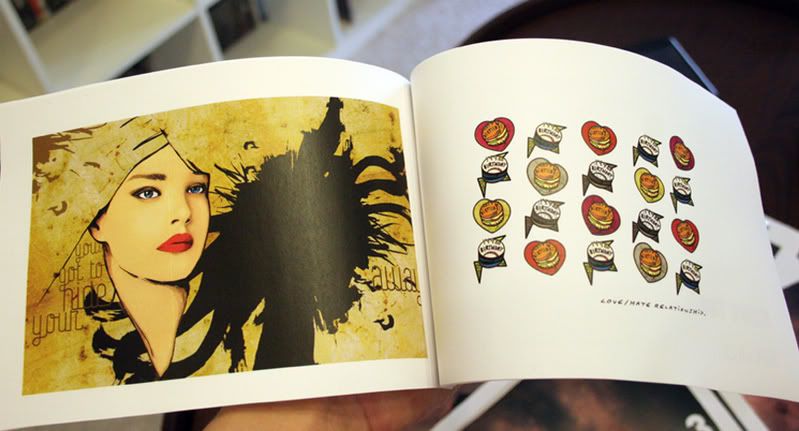
There's plenty of creativity if you look around for it. Now, if you're looking for art, sure, we have the Modern Art Museum in Fort Worth, and sure there's the Dallas Museum of Art. But if you're looking for some good North Texan art, where do you go? Why, no farther than your mailbox if you read Vomitorium. He may be on break from his school - Art Institute of Dallas - but Brice Baum certainly has earned himself a nice spot of relaxation. Not only has he busy with classes, but this nifty artist has formed a collective and independent art magazine, Vomitorium, which showcases some fabulous North Texan artists who have a shared love of poignant, powerful, progressive contemporary art. In example...:


Intrigued, are we? But you may be asking, how does this tie in with Voilà!, or with music? Well first off, Voilà! is a non-profit and totally voluntary effort, so we're all about DIY'ing it up, and are for independent productions, be it in the musical, artistic, or activism scenes; getting one's feet off, as it were, is the first step, and we applaud such efforts graciously. Secondly, Vomitorium supports fellow artists by collaborating together to make one nice, sexy magazine; Voilà! is collectively gathering tons of writers to present some excellent music discussion. It's like we're siblings! ...Er, well, maybe first or second cousins, but I'm sure you get the drift.

Thirdly, finally, did I mention Zicole Marxen was featured in the latest issue of Vomitorium? Where are my manners?! Zicole Marxen belongs to the eclectic company of musicians in Mount Righteous, from the DFW. Something like a Texan version of a high school marching band that collided with a parade held by I'm From Barcelona, these folks are making a lot of noise in a very big way, and you'll definitely hear more about Mount Righteous on Voilà! in the coming weeks.

But I digress. Vomitorium, Issue No. 4, is currently for sale on the Vomitorium Myspace for a measly $6.50. The latest issue features the talented works of Z. Marxen, Katie Kader, Sean Lester, and of course, entrepreneur Brice Baum. You can find yourself many a magazine, sticker, t-shirt, and other lovely knickknacks as well, all available at the Myspace! And just for your eager ears, catch Mount Righteous on their Myspace, right over here.

Tuesday, August 19, 2008

From Classics to Indie: A Memoir of a Musician

"The heavens at my birth intended me for stardom, rays of light shone down on me and all my sins were pardoned."


My life begins in darkness. I'm a struggling entity, searching the furthest depths of unknowingness ever imaginable. Of course, we all begin this way. Our first sights are lost with time, as are most things, our first tastes, our first birthday cake, the first time we pick up a crayon and scribble nothing onto a sheet of construction paper. Our parents savor these moments, tack them up on walls, refrigerators, talk up their friends at dinner parties. The shroud of memory that is our childhood is only survived through video cassettes, fading polaroid captures, or perhaps the occasional glimpse in our minds.


The Sound


My dad had a really nice stereo when I was growing up—like, way too expensive to exist in our house, something that made the rest of our possessions feel like crap. He wasn't as extreme as my uncle was, the one that had an entire room in his basement, each wall from floor to ceiling, covered in C.D. racks and vinyl records, but he did have an entire closet full of tapes, C.D.s, vinyls, movie cassettes, and everything else one could imagine had the capability of containing some sort of sound and/or video recording. I can remember the names of bands on cassette tapes that sat eternally on his tape rack overlooking the couch—names of bands I didn't even know most of, but I remember them cause I would just look at them for hours. Cheap Trick, Led Zeppelin, Moody Blues, Grateful Dead, The Police, The Sex Pistols. The house was pretty much attuned with his stereo, always something playing, whether it was classic rock, jazz, or whatever, I find most of my musical taste directly aligned with what I heard as a kid. Led Zeppelin remains today one of my favorite bands, despite being primarily in the 60s and 70s, the core of which no longer is alive (John Bonham, quite possibly the greatest rock drummer to ever grasp a pair of sticks), and they have inspired me amazingly in the music I write for my band today.


It was probably Elton John—the first music I paid attention to. I remember he was on the Muppet Show, his frilly glasses and top hat. That sort of thing seems to grab the attention of a 6 year old. I knew all the lyrics to his songs, I knew the piano parts (or at least what they looked like, I couldn't play piano, and still can't very well). I would sing them all the time, around the house, during school under my breath, at the dentist's (that nitrous stuff would do weird stuff to me when I was young...). Now, I don't still know all his song's lyrics... just some better than others, my memory isn't that good.


Elton progressed through my dad's collection—Costello popped in there, along with Billy Joel and Tom Petty. My mom was into Paul McCartney a lot, so I heard a lot of Wings and Beatles as a kid. I loved the song "Elephant Talk" by King Crimson, still to this day it's probably the only song of theirs I've heard more than once.


I don't claim to be completely absolved of stupid moments when it comes to music. In spite of picking up the drums in 3rd grade, it was hard for any elementary schooler to avoid the likes of boy bands and pop music on the radio. All I can say to defend myself is that I have completely abstained from the radio in the last 5 years, which is hard to do, but well worth it. Where was I?


The Big Black, Round Thing that Made Really Cool Sounds


It was a cultural arts exhibit thing that our school had every year—displaying the different mediums used all over the world. In the gym, a local drummer had set up an exhibit full of the percussion instruments I would come to cherish in the years to come—apart from the typical trap set we all know and love, there were xylophones, wood blocks, cowbells, congas, bongos, gongs, and everything else a musically starving kid could ever dream of. My life then was defined, I was meant to be a drummer.


I know it was early to make this decision, but my parent soon bought me a drum set for my birthday, I got lessons from the same man behind the exhibit at school, and within a year I was learning from a recording artist at a real studio as a part of a mentorship for my class. I recorded a few songs, both drums and vocals, and even fooled around with a synthesizer/keyboard when he was finalizing the recordings with his friend. As far as a cool experience could go, that was probably the coolest thing that happened to me before High School when I got to play basketball games and jazz concerts. My drum roots are in jazz, cause thats mostly what I learned from my teacher, along with some funk beats, but mostly different styles of jazz. I played with the jazz band in Middle School for one year, but it really wasn't my thing at the time, whether it was too basic as most Middle School music was, or I just wasn't ready for it, I gave it up for the time being.


It was Middle School that I found confusion in what I was musically into. I think it wasn't until 7th or 8th grade when I discovered System of a Down, which acted as a gateway to the newer music scene. The new rock radio station played cool stuff most of the time, I got into Queens of the Stone Age, and Foo Fighters, too bands I still listen to currently. Audioslave probably came in 8th grade. I was attracted to these bands because of the drumming. They all have really good drummers, John Dolmayan of System, Dave Grohl of Foo Fighters, etc. I needed this, to discover a scene of music, even if they were main stream, on my own, and not because it was what my dad played on the stereo all day. I needed to find my own meaning in music, rather than what I had been told my meaning was.


The Annoying Band Dylan Played That I Eventually Got Obsessed With


I was at Peter's house, a friend of mine. We were filming a movie for class, although it didn't possess much factual basis (our movies were meant to entertain not enlighten). Dylan was there, I think he was in the movie too, for some reason. Well anyways, he was into a lot of indie music, he still is, and he would just play tons of weird shit none of us knew, and he would marvel at the amazingness of each song (yes, I know amazingness isn't a word, shut it). This became a moment that would change my life forever. I think Dylan liked the song cause it had the word knickers in it... or something like that. I thought it was annoying. I didn't know it then, but I would eventually come to hum this song to myself, perpetually fixed upon it, determined to memorize its lyrics, find the band that sang it, see them live perhaps. I think I talked to Peter about it later, and it turned out the band was coming to the WOW hall (our local concert hall) sometime that year. This was back when they were small time, we managed to squeeze our way to the front of the room to see the band closer than any others in the place. I was in awe the entire show, although I didn't know one word of one song until they played the one I had heard. It's called Billy Liar—"Billy Liar's got his hands in his pockets, staring over at the neighbor's, knickers down. He's got his knickers down."—the hit song by the Decemberists, my favorite band even to this day. I saw them live in March of 2005, my sophomore, knowing only one song. I raided my friend's computer for all he had of them, downloaded (purchased of course) their newest album the next week when it came out, and by the time they came back to town that september, I had memorized every song, every note, everything that one could possibly memorize about a band. Colin, the frontman, played a live show over the summer that I had downloaded the music from, and he played new songs then that no one had even heard, and when the first note plucked in the concert I attended in the fall, I knew exactly what song it was. My friends were shocked at my obsession (more like... "dude get a life"), but I knew that it would someday pay off, I would find others who shared my devotion. I've seen them 5 times to date, two times on two consecutive night. I'll probably go to every show of theirs that I can until I die, or can't move. I probably won't get someone to move me to a concert. And they'll all be dead before I can't move anymore...


The point is that the band opened me to a whole new world of music, the indie stream, out of which so many amazing and inspiring bands I have discovered. Death Cab was probably first, since they were pretty popular coming out of the indie scene to a major label. The rest was an avalanche falling down upon me, I wouldn't even know where to start. I only know where it's gotten me: my favorite bands mostly consist of indie groups from around the world—Spoon, Iron & Wine, The Shins, Nada Surf, Ben Kweller, Mountain Goats, Say Anything, Riley Kiley, Arcade Fire, Arctic Monkeys, Secret Machines, etc. I ditched the radio, found it hard to trust. It was much more reliable to find a band online, or what friends recommended, and just listen to all you can of those bands.


These days, I listen to those bands aforementioned, a lot of Pink Floyd, various mainstream and indie bands, and all of this is pooled into the music I write for my band, The Epitaphs, for which I sing and play drums. You'll find my tastes often eclectic, and sometimes predictable, perhaps you may even disagree with it, but that's why it's MY taste, and not yours. We each have our own histories in the music scene, events that occurred that brought us to listen to whatever we listen to, things that shaped our inner ear long, long ago. You'll probably also find it that there isn't music I won't listen to—just because I hate country music, doesn't mean I didn't give it a shot. It isn't for me, thank god. I like what I like, drop me a line if you want to talk music, or anything really. I'll keep tabs on the bands I read of here, and try to listen to as many as I can. My life is pretty much defined by music, and since my life is still changing, and growing, I have to spend my time doing something.


(P.S.) I just wrote this in like an hour...


--April Marches On...--

Monday, August 18, 2008

Commercialization Of Music


I've realized that I am truly against this hardcore commercialism of music.

I mean, I totally understand putting up a flyer for your band's show, getting the word out to your fanbase, but I think that what makes music what it is are the motivations of the people that are making it.

When I play a show, I don't want to see a crowd full of "potential fanbase". When I play a show, I want to make a connection with myself and whoever is listening. I consider a show a success if even just one person in the crowd is really feeling a song I'm playing. If even one person is listening to a song and remembering something that happened to them, or realizing that they have felt the same way before, or even if someone is listening hard enough to critique me, I believe the show is a success. I'm not into making whatever music will get me a few bucks and some chicks to follow me around. If those are your motivations, that's totally fine. I think your music will reflect that.

I pour my heart and soul into my songs. Even if I am playing for a crowd of people, I think what I'm doing is an extremely personal endeavour. My ideas about music are entwined with my religious views. I believe there is a connection between all human beings, one that we can't fully explain, one that we attempt to explain through religion. The ideas that are put in front of me about God or religion as an explanation for things we don't understand do not satisfy me. I don't feel fulfilled. Many people say they feel a connection with God. I have friends that say they can speak to God, have conversations with Him, He guides their lives. I would love to have that kind of faith, to feel that kind of connection so easily, but its simply not there.

The closest thing to this kind of connection, for me, is music, or any creative art form. Two people, devoting every ounce of emotion in their bodies and feeling, for even a moment, at complete peace with one another. I think that's an amazing thing, and once I had experienced that, I no longer saw any reason in not trying to recreate it.

So here I am, making music.

That is why it really bothers me to see performances reduced to sideshow attractions, numbers on a page, financial income, generic noise packaged and sold in bulk to hungry consumers who will hopefully throw their money at t-shirts and refreshments at an impersonal mockery of music called a show.

I guess I just have to be careful what I pursue.

Thursday, September 20, 2007

Post-Rock


Post-rock. It's a fairly new genre, with roots merely beginning in the mid-to-late 90s, starting with bands such as The Sea and Cake and Laika. Post-rock really started picking up some steam when Tortoise emerged on the scene, and has only grown sense. Boasting bands that have gained an undeniable amount of credibility with their music such as Godspeed You! Black Emperor, Mogwai, Explosions In The Sky, Do Make Say Think, Sigur Rós, and even encompassing bands such as Mouth of the Architect and The Books under the genre's wing. But what IS post-rock?

Most simply, post-rock is a clash between a wide variety of music, new and old, mixing forms of minimalist, shoegaze, with genres like jazz, minimalist, and even classical. Post-rock can be classified as "rock," in so much that it uses modern instruments (electric guitar, electric bass, drums, etc.), in a somewhat contemporary fashion. But this is about as near that post-rock encroaches upon the realms of contemporary rock music.


Typically, post-rock is associated with a few main details: the music is instrumental, it uses repetition by one or more instruments to produce a complex, textured sound, and gives off a very cerebral, ambient vibe. The easiest way to view post-rock is viewing it in relation to post-modern art. As modern artists painted their works, following doctrined rules to make detailed compositions, post-modern artists rebelled against these rules, and made intricate pieces without restraint. Post-rock uses this same concept in it's inception: direct opposition to the formally unwritten dogma of modern rock to produce ambient rock, disconcordant to that of previous stylings, yet encompassing everything that makes modern rock interesting. Post-rock is a direct rebellion from the typical styles you'll hear from anyone else.

But what makes a post-rock artist tick? What makes them specifically different than other artists? This is still a debate that is highly contested among critics and average listeners alike. Sure, there are those bands which, if post-rock was uttered in casual conversation, would instantly have fingers pointed at them, for their higher notability in the field such as Godspeed You! Black Emperor and Mogwai. But there are other bands as well who, since post-rock's inception, are now on the border of post-rock and indie rock, or other similar genres, such as experimental music or space rock, et cetera. Bands such as Grizzly Bear, The Arcade Fire, and Broken Social Scene have occasional dubbed post-rock. Particularly speaking on Grizzly Bear, who uses strong amounts of harmony and ambiance within their music to create a very post-rock-ish feel, are generally labeled as indie rock, even though they directly share many of the the qualities of post-rock bands. Furthermore, there are bands, namely Mogwai, who most would say lie directly within the realms of post-rock, who put down the term in relations to themselves.
Generally though, bands with a strong emphasis toward instrumental, ambient music, with strong use of repetition or far fetched composition styles are generally coined post-rock. Despite there differences (and their similarities for that matter), post-rock generally follows those few trends. Vocals can be used, but will generally not be used in direct relation to the song, rather as a part of the composition itself, such as harmonizing of several singers. Otherwise, lyrics will generally be perpendicular to the music itself, either speaking phrases that don't necessarily fit together cohesively, or simply spoken word, not in time with the song itself.


Several bands within post-rock, despite criticism against their being inducted with the genres boundaries, are worth noting. Most prominent are those from the self-made capital of post-rock, Montreal, Canada. This primarily references Godspeed You! Black Emperor. GY!BE, as they're often referred to, has slowly built their music completely in opposition to modern rock. Rather than creating music styled with verses, chorus, hooks, and bridges, GY!BE composes movements in example of classical music, earning them the genre of avant-garde in modern day society. Their compositions generally stretch upward of 10 minutes a piece, their longest reaching above 30 minutes. The entire composition is effectively issues a wide range of repetition and depth that can only be achieved through such drawn out musical content, and GY!BE is not shy to put strong crescendos in their music.

But as of 2003, Godspeed announced that they would enter into an indefinite hiatus. In the wake of the bands hibernation from music, there has been an influx of bands spawned from former GY!BE members to continue the post-rock movement so related to Montreal artists, names like A Silver Mt. Zion, Fly Pan Am, and Set Fire to Flames.

On further note of large bands becoming newer, further intricate bands, the discussion of post-rock can't continue without Broken Social Scene. BSS is one of the borderline post-rock artists, only setting themselves apart from the genre with emphasis toward lyrics, though they tend to be disconcordant at times to the entire piece of a song. Broken Social Scene already uses strength of repetition to their advantage with their music, particularly in songs like KC Accidental from You Forgot It In People, but their lull in music-making has influenced their huge company of musicians to take on solo projects, some of which are in the realm of post-rock. Most notably would be Do Make Say Think, formed by Charles Spearin and Ohad Benchetrit. Incorporating a more electronic style, with a mix of jazz, they use everything from keyboards to brass instruments to create their ambiance. Bands such as Valley of the Giants, coined "post-rock supergroup" by their Wikipedia page, is a direct alignment of Canning and Spearin from Broken Social Scene, and Sophie Trudeau from GY!BE and A Silver Mt. Zion, bringing direct relation between Broken Social Scene and post-rock. Furthermore, bands like Bell Orchestre, a completely instrumental band with full-time members of The Arcade Fire among their party, bring in borderline post-rock bands in a full circle of inclusiveness.

Explosions In The Sky is a another leader of the post-rock music. Coming from deep in the heart of Texas, Explosions In The Sky quickly live up to their name. Going from cool, solemn high notes, played discreetly and serenely, even complete and total ambiance, to an all out castrophonic ejection of sheer explosive noise in mere moments. From the violent and turbulent, to the peaceful and soothing, the trio of electric guitars mixing their delicate sounds into intricate textures, balanced out with drums, summarizes perfectly that picaresque American view of middle-of-nowhere west Texas.

It should also be further noted that just because some of these bands are taking a break from their music, while fans await future music by bands such as Mogwai and Tortoise who continue to produce new material, it is not to be said that the giants among the genre are the only artists making post-rock. Post-rock is constantly attempting to evolve with new artists springing up in example of more recent talent such as Explosions In The Sky. New artists such as This Will Destroy You, destroyalldreamers, God is an Astronaut, All About Max, From Monument to Masses, The Paper Chase, Post Harbor, Astrobotica Supra De' Nova, and Japancakes are pushing the boundaries of post-rock as we speak, testing out new sounds, new harmonies, and new formulas to take this new genre to heights never before imagined.


Post-rock is a testament to music, one which states loudly and boldly, in ways truly unique to it's own, that music is an evolutionary movement, which will never die, but slowly grow into new plains that defy the realms of that which is labeled modern and standard.


The Arcade Fire


To be perfectly truthful, when I first heard about The Arcade Fire about two or three years ago, I was very analytical with them. This was before I was really immersed in this dense music scene known simply as "indie," so I was thoroughly out of the loop at the time.

But I caught wind of several of the songs off their latest album at the time, Funeral, and was intrigued. The mix of harmonic lyrics that were quite deep though vague, with extended instrumental ritornelles featuring heavy emphasis on string instruments like violin and cello, was a huge shift in most of the general music trends I had been hearing. Not only did that make them thoroughly stand out, but also their blaring electric guitar riffs are truly unique - hearing them paired with the already thematic elements that the string instruments (as aforementioned: violin, cello, etc.) invoke, the waves of sound plaster your senses with thoughts and feelings.

When the video for Rebellion (Lies) premiered on MTV2 (I was an avid viewer at the time - this was when I began to realize how grotesque and poisonous MTV is to independent artists), I was hooked. I soon after got the cd, sat down, and gave it a listen.
But somehow, I was more disappointed than I figured I'd be.

Neighborhood #1 introduces the album, starting quiet until it builds into a crescendo which sets a strong mood and speed the album is to follow. Neighborhood #2 comes next, taking that speed to another level. Une Annee Sans Lumiere is your breather with a slow song before they burst forth again with Neighborhood #3. The entire record thus far is a steady, progressive ride, and quite exciting.

But to change the mood, they follow with Neighborhood #4. Now don't get me wrong, it's a great song. But the switch from VERY fast, to significantly slower threw me off. Then they slowed even more with Crown Of Love, a very emotional, very slow tune. It's not like I'm against slow songs or anything, but this huge switch in mood and speed turned me off to the rest of the album. I got frustrated with Funeral, and at this point in the album would tend to put it away. I would usually be found calling Arcade Fire "good, but overrated."


Well, a long time of disinterest passes until I find myself wandering iTunes and see their self titled EP. I thought, hey, why wouldn't I give it a go? I can't have a well rounded opinion without hearing more of their material, right?
I really love their EP - it's unique compared to their other works. Almost the whole album takes a slower speed, therefore making you be patient with their music. They also tended to stay on the quiet side; their form developing had not granted the long, mind numbingly symphonic instrumentals that I adore in their style. But all the songs have some sort of hook, and can keep you interested. I gained a better opinion of them, but was stubborn; The Arcade Fire now regained my listening pleasure, but they haven't proved themselves just yet.


This year, they finally released their latest album, Neon Bible. I still held the idea that they were put on their pedestal by pretentious snobs who read too many Pitchfork articles. But eventually, I broke down and gave Neon Bible a chance.

I was dumbfounded. The ENTIRE album is progressive; Neon Bible takes advantage of their speed with mostly fast songs. When they do transition into slow songs, they have their rightful place inbetween their more hasty counterparts. Also, calling them quiet is an injustice in itself, they keep them progressive, and they can have their strong outbursts of noise; the transitioning from fast-to-slow-to-fast works well, and only the song Neon Bible seems a bit forced into place, but is quickly forgiven with it's content.

Furthermore, the heavy instrumental breaks I fancied from Funeral were given strong emphasis, and are always a delight to hear, especially since the songs are crunched down in to hyper, fast paced rushes of sound.


I have since fallen in love with Arcade Fire, and have a strong respect for their music now, new and old. It's hard to say whether Neon Bible or Funeral is better. I'd almost be willing to say Funeral due to the more complex songs, but with moving tracks such as Keep The Car Running, (Antichrist Television Blues), Intervention (with some ASTOUNDING church organ playing!), and a reprise of No Cars Go, it'll forever be debated with myself, I predict.

One note that sets Neon Bible apart from Funeral is their recording processes. While Funeral had a significant amount of it's material recorded at the infamous Hotel2Tango, (think about bands like Godspeed You! Black Emperor, Bell Orchestre, Wolf Parade, A Silver Mt. Zion), Neon Bible was recorded at a series of churches, most notably at St. James Anglican Church in Quebec, and most profoundly at Eglise St. Jean Baptist, Montreal, where they were able to record Intervention and other songs with a real pipe organ. But the audio recorded within these churches brings a whole different feel if you have room to respect the quality. It's hard to shake the imagination of the band just playing away near the altar, the wonderful melodies bouncing off stone walls and shaking the stained glass.


It is the bands I listen to, such as The Arcade Fire, which make me love music. I'm eternally indebted to my music the items of: one infinity, and maybe a cup of warm, sweet tea, for teaching me how to think, feel, and be. This is why I love music.